
- What is an apartment?
- What is a condo vs apartment?
- What is the difference between a condo and an apartment for a renter?
- Condominium vs apartment: who pays the HOA fee when you rent?
- What is a townhouse, and how is it different from a condo or apartment?
- What is a duplex apartment?
- How do condo, apartment, townhouse and duplex compare side by side?
- What does each one cost to rent in 2026?
- What's the difference between a condo and an apartment under Tennessee and South Carolina law?
- Apartment vs condo vs townhouse: which should you rent?
- How Right Time Homes fits the condo vs apartment decision
- Frequently Asked Questions
- Sources
In brief: A condo is an individually owned unit whose common areas belong to all owners jointly (Tenn. Code 66-27-102; S.C. Code 27-31-20), so a condo renter's landlord is a private owner. An apartment is a unit in a building owned by one landlord. Townhouses are attached multi-story homes, 17 percent of single-family starts in Q2 2026 (NAHB), and a duplex holds two homes. In 2026, Zillow put typical multifamily rent at $1,786 and single-family rent at $2,314.
Condo vs apartment is one of the most searched housing questions in the United States, and the confusion is understandable: from the sidewalk, the two can look identical. The difference between condo and apartment is not the building. It is who owns the unit you live in, who answers your maintenance call, and which set of rules governs your lease. Add townhouses and duplexes to the comparison, and most renters are suddenly choosing between four different living arrangements that each come with their own costs and trade-offs. This guide explains what is the difference between a condo and an apartment, what a townhouse and a duplex actually are, what each costs to rent in 2026, and how the rules differ for renters in Tennessee and South Carolina.
What is an apartment?
An apartment is a self-contained residential unit inside a building that contains other units, where the entire building is owned by one landlord or company and every unit is rented, not sold. You never own an apartment; you lease it, and the property manager or owner handles repairs, common areas, and building rules.
In everyday American usage, "apartment" describes a rental. The Census Bureau does not use the word at all. Its American Community Survey classifies homes by "units in structure," and apartments show up as structures with 2 to 19 units or 20 or more units. In the Census Bureau report Housing Availability and Affordability: 2023 (published September 2025), 16.4 percent of all U.S. housing units were in buildings of 2 to 19 units and 10.6 percent were in buildings of 20 or more units. Put together, about 27 percent of the national housing stock is multiunit, and that is where most apartments live.
What makes a rental an apartment is the ownership structure: one owner, many renters, one management office. A 300-unit garden complex in West Knoxville, a 12-unit brick walk-up near downtown Rock Hill, and a converted historic building with eight units are all apartments if one entity owns the whole property and leases the units out. The landlord is a business, the lease is usually a standardized form, and the building is operated as a single rental enterprise.
That single-owner structure explains almost everything renters notice about apartment living: on-site maintenance staff, a leasing office with set hours, uniform appliances across units, and amenities such as a pool or gym that are budgeted as a cost of doing business rather than funded by an owners' association. It also explains why apartment rules tend to be consistent and why rent increases are set by a management company's pricing model rather than by one individual owner.
What is a condo vs apartment?
A condo (condominium) is an individually owned unit inside a building or community where the common areas are owned jointly by all the unit owners. An apartment is a unit in a building owned entirely by one landlord. Rent a condo and your landlord is a private owner; rent an apartment and your landlord is the building's owner.
Both Tennessee and South Carolina define condominiums in statute. The Tennessee Horizontal Property Act, Tenn. Code Ann. 66-27-102(a)(2), defines "condominium" as "the ownership of single units in a multiple unit structure or structures with common elements." Confusingly for renters, the same statute calls each individually owned unit an "apartment," defined in 66-27-102(a)(1) as "a part of the property subject to this part intended for any type of independent use." So in Tennessee legal language, a condo building is made of "apartments," even though in everyday English we use apartment to mean a rental.
South Carolina does the same thing. The South Carolina Horizontal Property Act, S.C. Code 27-31-20, defines "apartment" as "a part of the property intended for any type of independent use" and defines "condominium ownership" as "the individual ownership of a particular apartment in a building and the common right to a share" in the common elements. Under 27-31-30, a property only becomes a condominium regime when the owner records a master deed declaring that intent. Without a recorded master deed, a building full of units is just a rental building, no matter how upscale it is.
People ask what's the difference between an apartment and a condo as if it were a question about architecture, but the difference between apartment and condo is a question about title. The practical upshot of what is a condo vs apartment is this: a condo is a form of ownership, not a type of building. The same four-story building could be an apartment complex this year and, after the owner records a master deed and sells the units one by one, a condominium next year. Nothing about the hallways or the floor plans has to change.
What is the difference between a condo and an apartment for a renter?
The difference between a condo and an apartment for a renter comes down to five things: who your landlord is, who fixes what, which rules apply, how standardized the lease is, and how stable the arrangement is. Condo renters deal with an individual owner plus an owners' association; apartment renters deal with one management company that controls everything.
Start with the landlord. In an apartment, the landlord is the property owner or its management company, and the person who signs your lease also controls the budget for repairs, staff, and amenities. In a condo, your landlord is whoever bought that one unit. They may live across town, in another state, or have never seen the unit since closing. Some are excellent, responsive landlords. Others own a single rental as a side investment and have no process for a 2 a.m. water leak.
Next, maintenance. Apartment communities employ or contract maintenance staff and usually have a formal work order system. Condo renters have a split: the unit owner is responsible for everything inside the unit (appliances, plumbing fixtures, interior walls), while the condominium association is responsible for the "general common elements." Tennessee's statute, 66-27-102(a)(7), lists those as the land, foundations, main walls, roofs, halls, stairways, and central service installations. If your condo's roof leaks, the association fixes the roof, but your landlord fixes the ceiling drywall inside your unit, and the two may argue about who pays for the ruined carpet.
Then rules. In an apartment, the lease and the community policies are the rules. In a condo, you are bound by your lease and by the association's declaration, bylaws, and rules, which can restrict pets, parking, noise hours, balcony use, move-in times, and even whether owners may rent units at all. The council of co-owners (that is the statutory term in both Tennessee 66-27-102(a)(5) and South Carolina 27-31-20(e)) can change those rules by vote, and a renter has no vote.
Lease standardization matters too. Apartment leases in Tennessee counties covered by the Uniform Residential Landlord and Tenant Act and across South Carolina under the Residential Landlord and Tenant Act are typically professionally drafted. A condo owner may use a form downloaded from the internet, which is where renters run into vague repair clauses and missing deposit terms. Our guide to lease agreements and every clause in them is worth reading before signing with a private condo owner.
Finally, stability. An apartment building is run as a long-term rental business. A condo owner can decide to sell at the end of your lease, move back in, or hand the unit to a relative. If the association later amends its rules to restrict rentals, the owner may be unable to renew your lease even if both of you want to.
| Factor | Condo (rented from an individual owner) | Apartment (rented from a management company) |
|---|---|---|
| Who owns your unit | One private owner holds title to the unit | One company owns the whole building |
| Who you call for repairs | Owner for inside the unit; association for structure and common areas | One maintenance team for everything |
| Rules you must follow | Lease plus association declaration, bylaws and rules | Lease plus community policies set by management |
| Amenities | Funded by owner dues (HOA fees of roughly $100 to $300 a month on average) | Funded by the operator's budget, included in rent |
| Who sets the rent | The individual owner | Management pricing, often software-driven |
| Risk of non-renewal | Owner may sell, move in, or face new rental caps | Low; the building exists to be rented |
| Finishes and layout | Varies unit to unit; often owner-upgraded | Uniform across the property |
| Legal definition | Tenn. Code 66-27-102; S.C. Code 27-31-20 | No statutory definition; a rental unit |
Condominium vs apartment: who pays the HOA fee when you rent?
In a condominium vs apartment comparison, the owner of a rented condo pays the association dues, not the tenant, unless the lease says otherwise. HomeGuide puts typical HOA fees at $100 to $300 a month, with a range from under $50 to $1,000. Owners usually fold that cost into the rent they charge.
This is why a rented condo and a comparable apartment often land at similar monthly prices even though the condo owner has a very different cost structure. The condo owner pays a mortgage, property taxes, insurance on the unit interior, and association dues, then sets a rent that covers all of it. The apartment operator pays for the whole building and spreads costs across hundreds of units. Neither is automatically cheaper; it depends on the local market and the owner's motivation.
Renters should still read the lease closely for pass-through charges. Some condo owners write in that the tenant must pay any association fines caused by the tenant's conduct (a reasonable term) or any special assessment levied during the lease (an unusual and expensive one). Special assessments are one-time charges the council of co-owners votes to fund a major repair such as a new roof or repaving. A tenant has no vote on that assessment and should not be paying it.
In an apartment, there is no HOA. Fees you may see on top of rent are things like trash valet, pest control, package lockers, or a monthly pet rent, all set by management and disclosed on the lease. Tennessee and South Carolina both require that the rental agreement be the source of any charge beyond rent, so a fee that is not in the lease is not owed.
What is a townhouse, and how is it different from a condo or apartment?
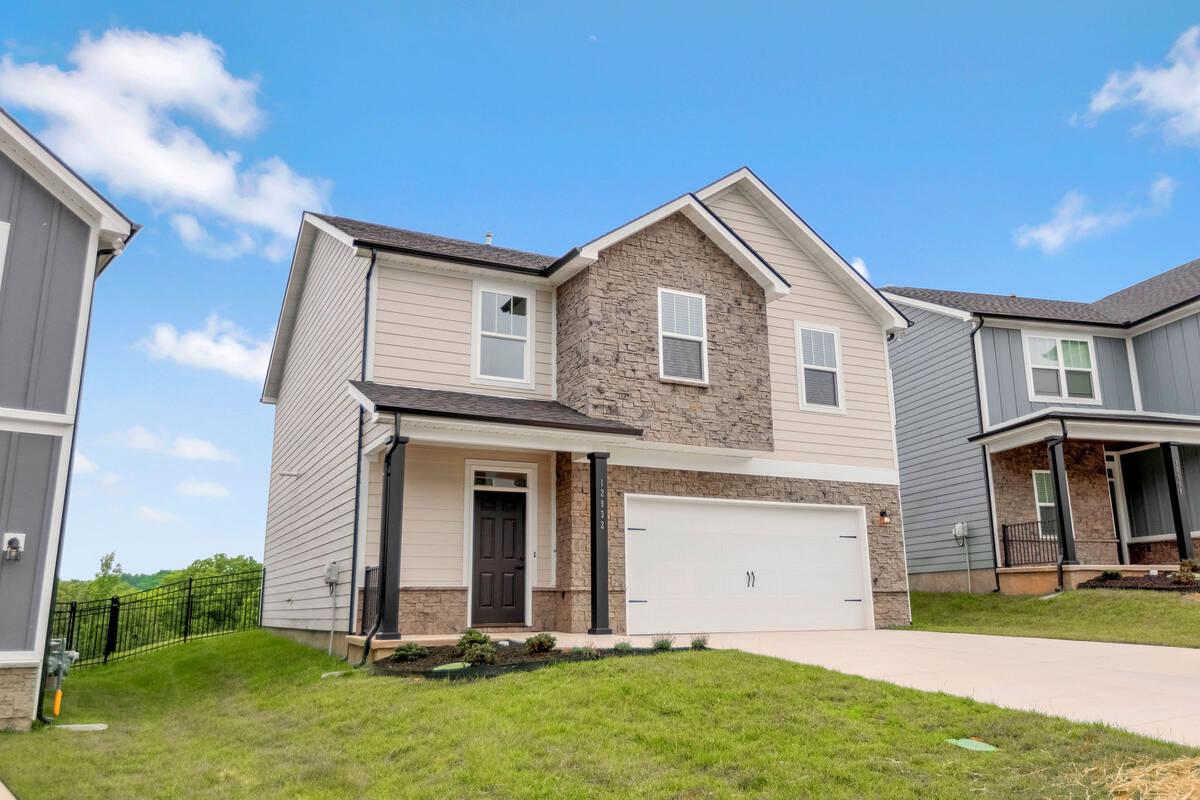
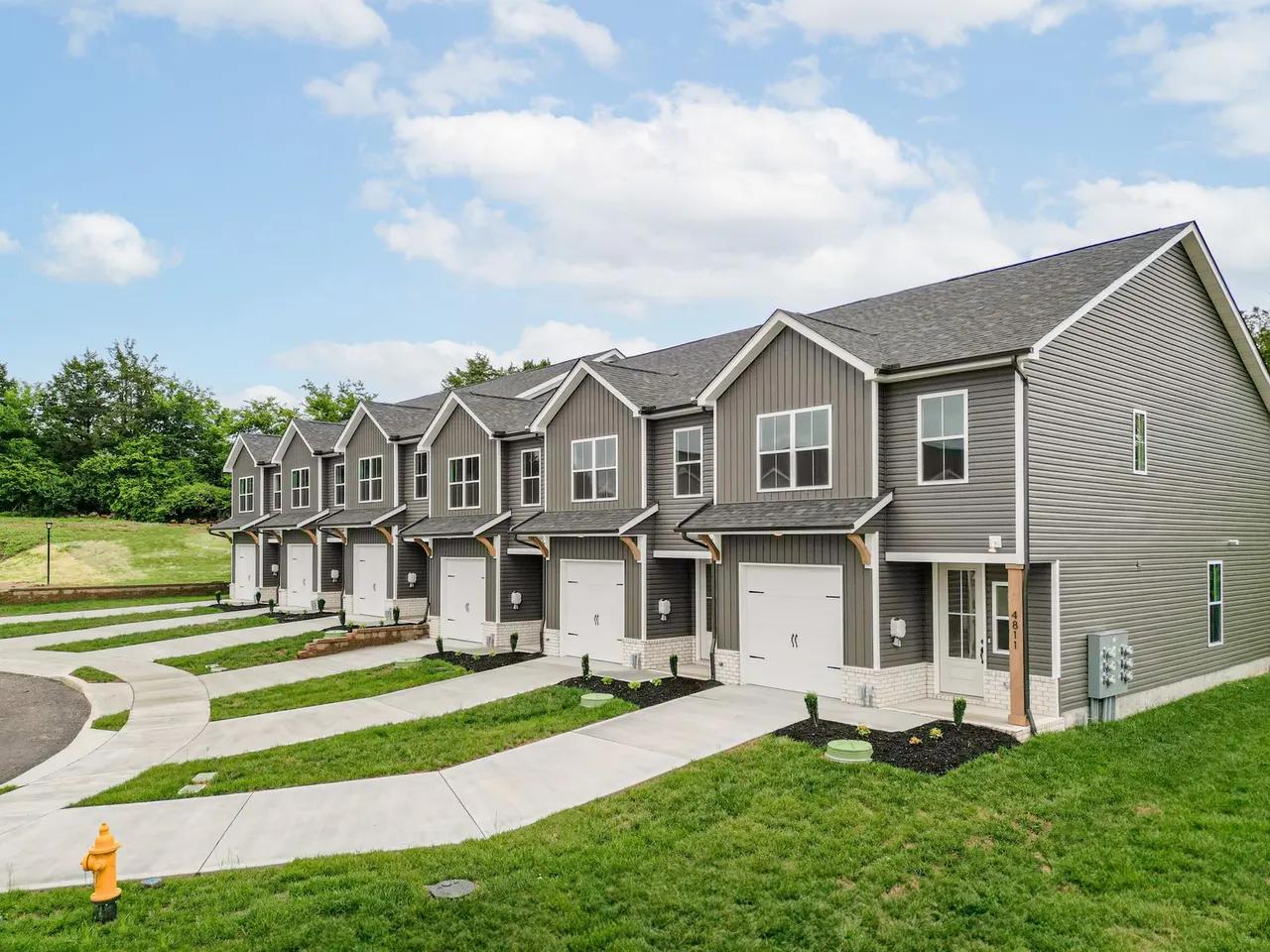
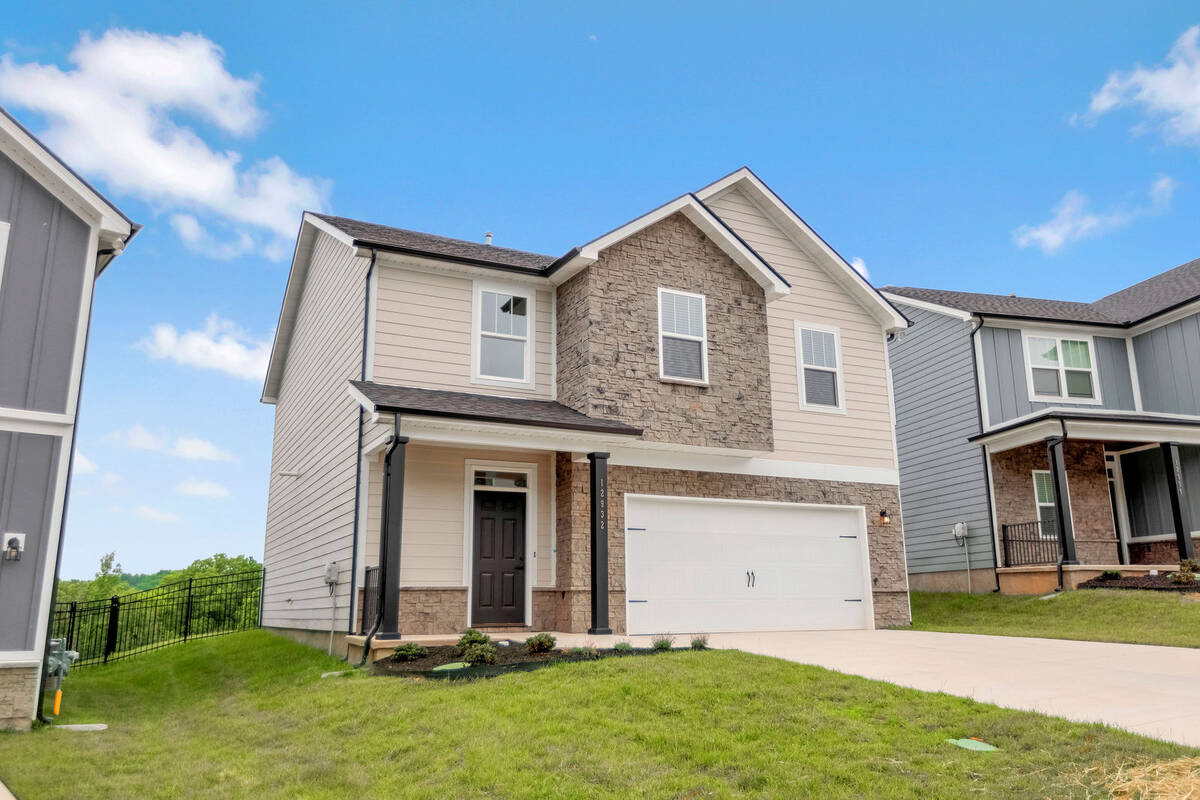
A townhouse is a multi-story home that shares one or two side walls with its neighbors and has its own front door at ground level, usually with a small yard or patio. Townhouses can be owned fee simple, owned as condominiums, or, in build-to-rent communities, owned entirely by one operator and leased like apartments.
The word describes the physical form, not the ownership. That is the source of much of the confusion in the apartment vs condo vs townhouse debate. A row of townhouses might be 20 individually owned homes with a small HOA for landscaping, or 20 condominium units where the association owns the exteriors, or 20 rental homes owned by one company. In the last case the experience is closer to an apartment (one landlord, one maintenance team, one set of policies) while the home itself feels like a house (no one above or below you, a private entry, often a garage).
Townhouses are a growing share of new American housing. The National Association of Home Builders reported in August 2026 that townhouse construction represented 17 percent of all single-family starts in the second quarter of 2026, with 42,000 townhouse starts in the quarter and 159,000 over the trailing four quarters. Builders like the format because it delivers house-like living on less land, and renters like it for the same reason.
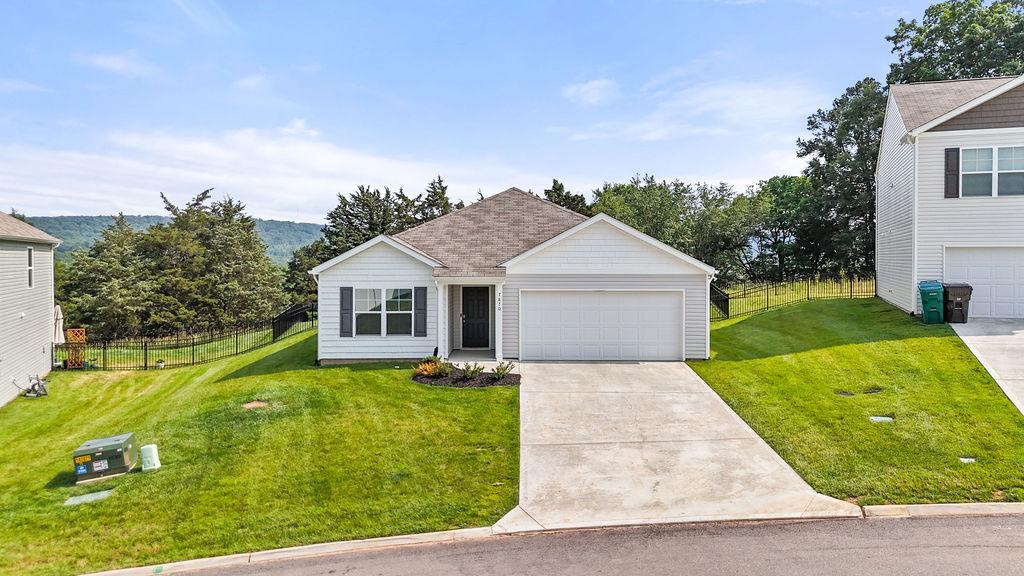
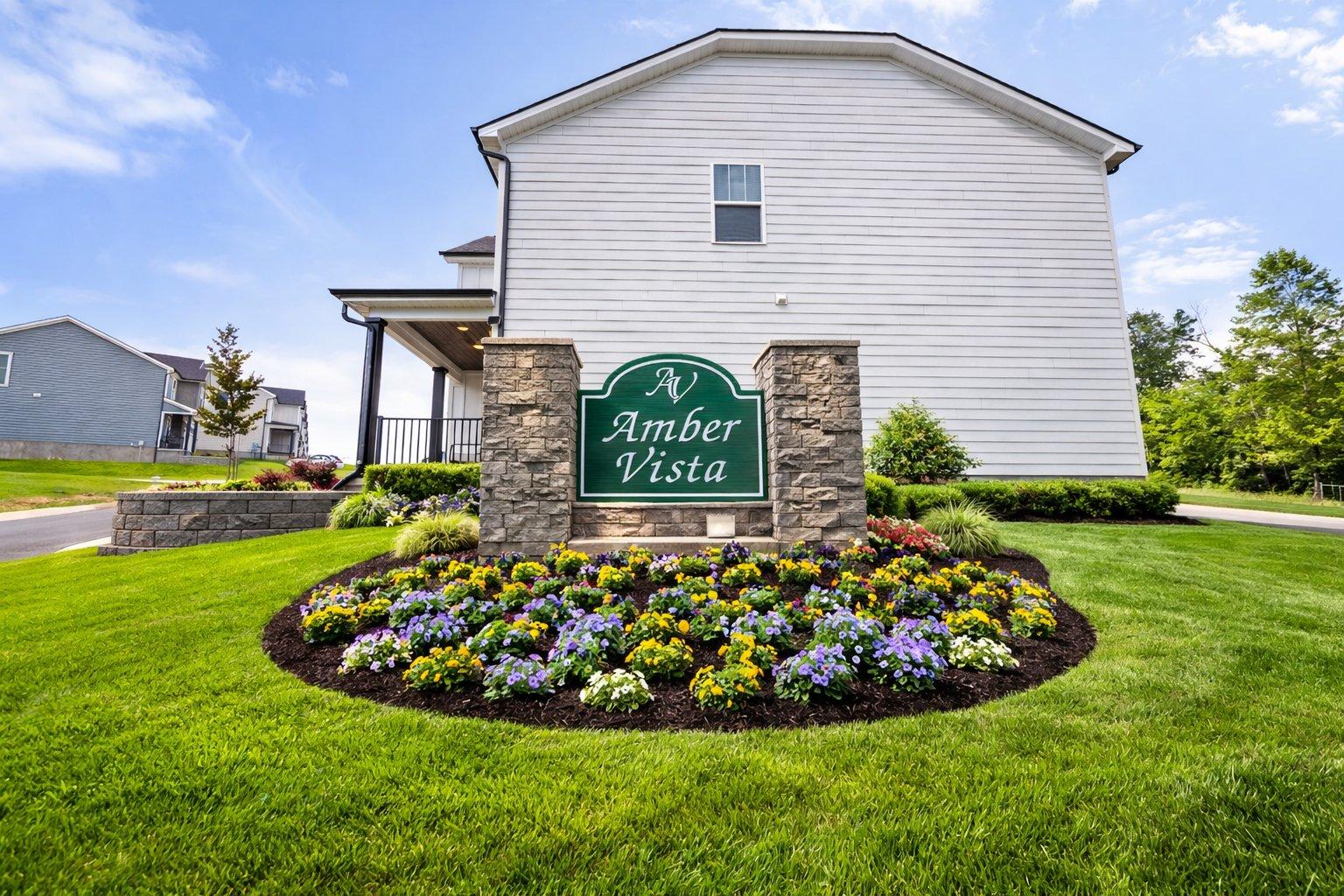
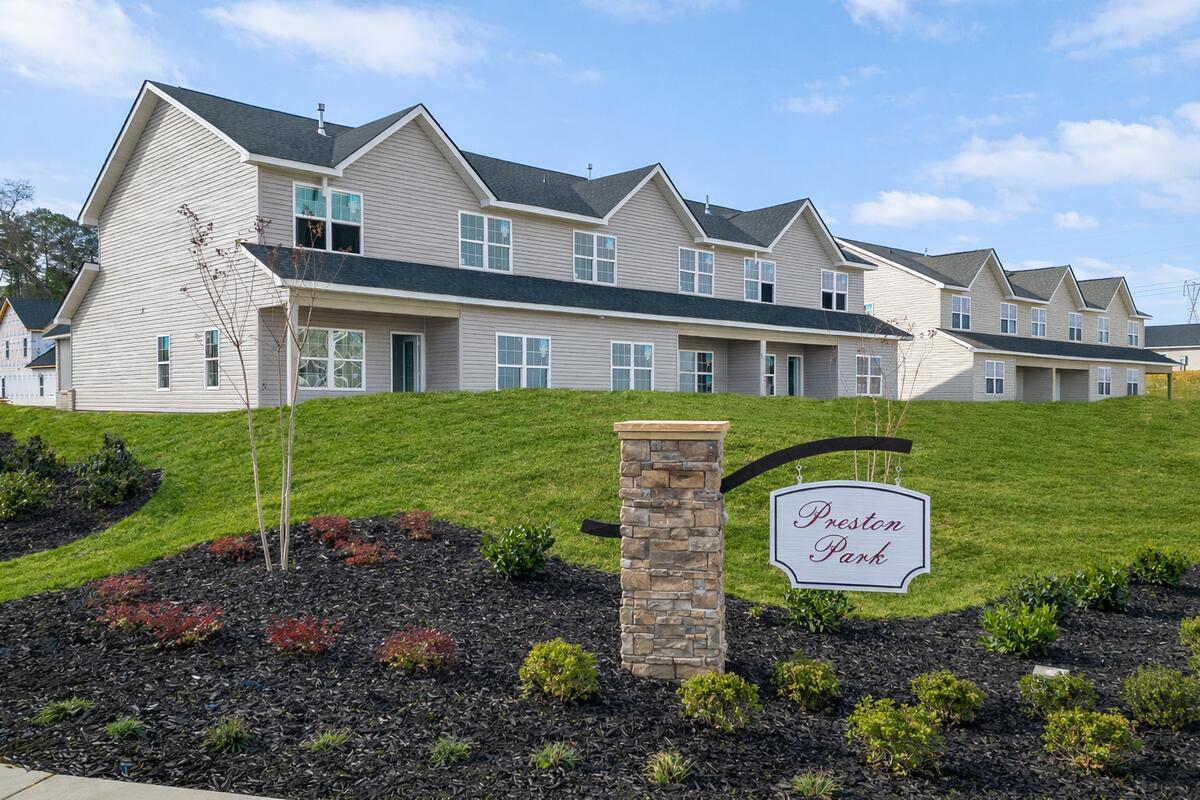
Single-family built-for-rent is a related trend. NAHB counted about 62,000 single-family built-for-rent starts over the four quarters ending in the first quarter of 2026, just under 7 percent of all single-family starts, compared with a historical average of 2.7 percent from 1992 to 2012. Right Time Homes' communities in Knoxville, Lenoir City, Rock Hill and Charlotte are examples of this model: new townhomes and single-family homes built specifically to be rented and managed by one company.
For a renter, the decisive questions about a townhouse are the same ones that separate a condo from an apartment: who owns it, who maintains it, and whose rules apply. A privately owned townhouse behaves like a rented condo. A build-to-rent townhouse behaves like an apartment with better walls and a yard.
What is a duplex apartment?
A duplex apartment, in most of the United States, is one of two separate homes inside a single building, typically side by side or stacked, each with its own entrance, kitchen, and utilities. In New York City, "duplex apartment" instead means one apartment that spans two floors connected by an internal staircase.
The Census Bureau counts duplexes as "2 units" in its units-in-structure data, folded into the 16.4 percent of housing in structures of 2 to 19 units. Zoning codes often call them two-family dwellings. The owner may live in one half and rent the other (a common first step for small landlords), or rent both halves. Because a duplex has only two units, it is almost never a condominium; it is usually owned fee simple by one person.
What is a duplex apartment like to rent? You get more privacy than a large apartment building, often a yard and a driveway, and a landlord who may live next door. You also get a very small landlord with no maintenance staff, no office hours, and sometimes no written repair process. Noise travels through the shared wall or floor, and the building's upkeep depends entirely on one person's budget. Tennessee's Uniform Residential Landlord and Tenant Act still applies to a duplex in covered counties, and South Carolina's Residential Landlord and Tenant Act applies statewide, so your legal protections do not shrink because the building is small.
A triplex (three units) and fourplex (four units) work the same way, and together with duplexes they are often called "missing middle" housing because they sit between the detached house and the large apartment complex.
How do condo, apartment, townhouse and duplex compare side by side?
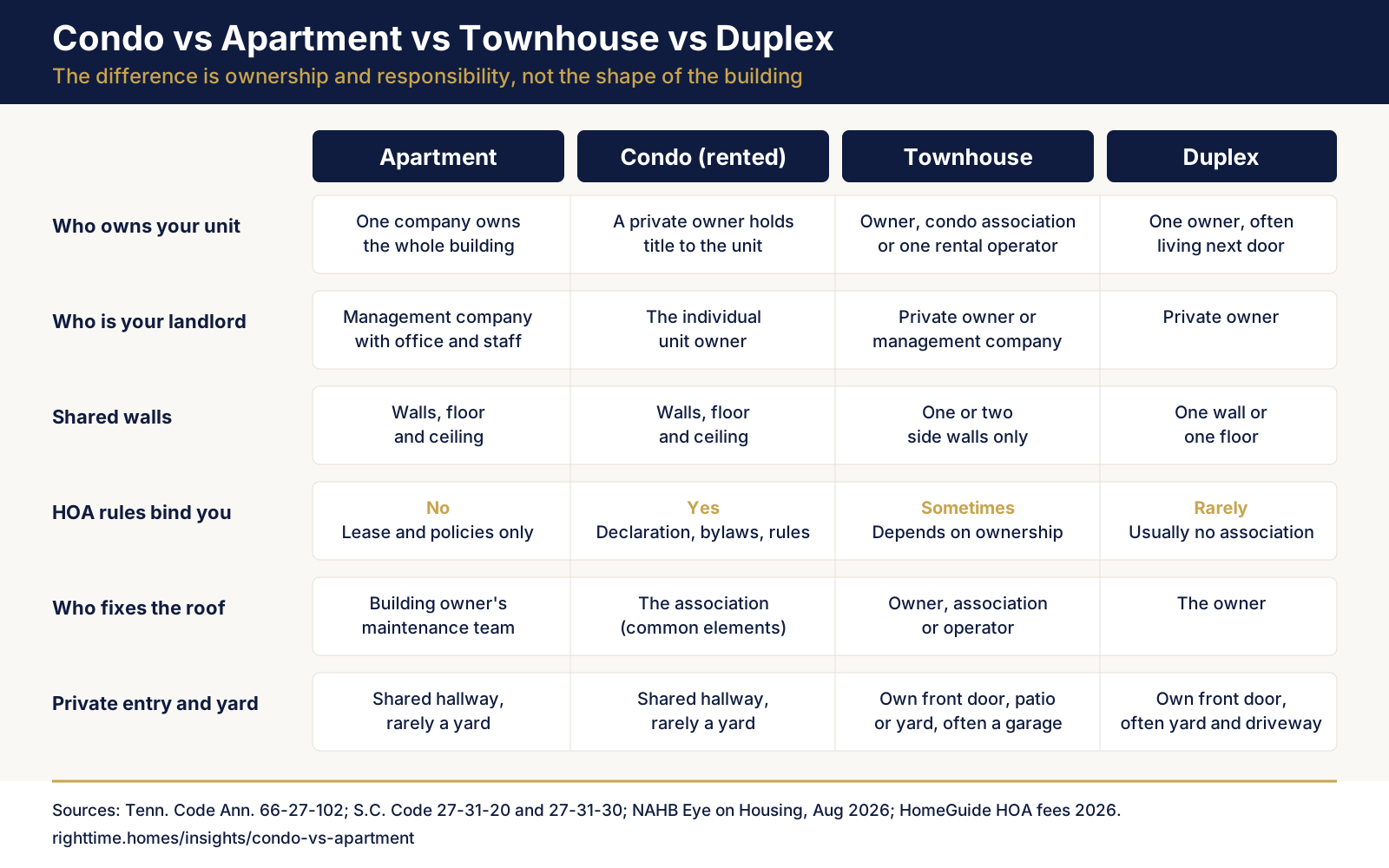
Side by side, apartments and build-to-rent townhouses offer professional management with the most predictable experience; condos and duplexes offer individual landlords with more variation. Townhouses and duplexes give you ground-level entries and often a yard; condos and apartments usually share hallways. The table below puts the four housing types next to each other.
| Feature | Apartment | Condo (rented) | Townhouse | Duplex |
|---|---|---|---|---|
| Typical owner | One company owns the building | Individual owns the unit; association owns common elements | Individual, condo association, or one build-to-rent operator | Individual, often living in the other half |
| Your landlord | Management company | Private owner | Private owner or management company | Private owner |
| Shared walls | Walls, floor and ceiling | Walls, floor and ceiling | One or two side walls only | One wall or one floor |
| Private entrance | Usually a shared hallway | Usually a shared hallway | Yes, at street level | Yes |
| Yard or garage | Rare | Rare | Often a patio or small yard, frequently a garage | Often a yard and driveway |
| Who fixes a leaking faucet | On-site maintenance | The unit owner | Owner or community maintenance team | The owner |
| Who fixes the roof | Building owner | The association | Owner, association, or operator | The owner |
| HOA rules apply to you | No | Yes | Sometimes | Rarely |
| Share of U.S. housing (Census 2023) | Most of the 27% in 2+ unit buildings | Part of the same 27% (ownership form) | Most of the 6.3% single-unit attached | Part of the 2 to 19 unit group |
| Best for | Convenience, amenities, predictability | Upgraded finishes, owner-occupied building feel | Space, privacy, families, pets | Privacy on a budget, small-landlord relationship |
What does each one cost to rent in 2026?
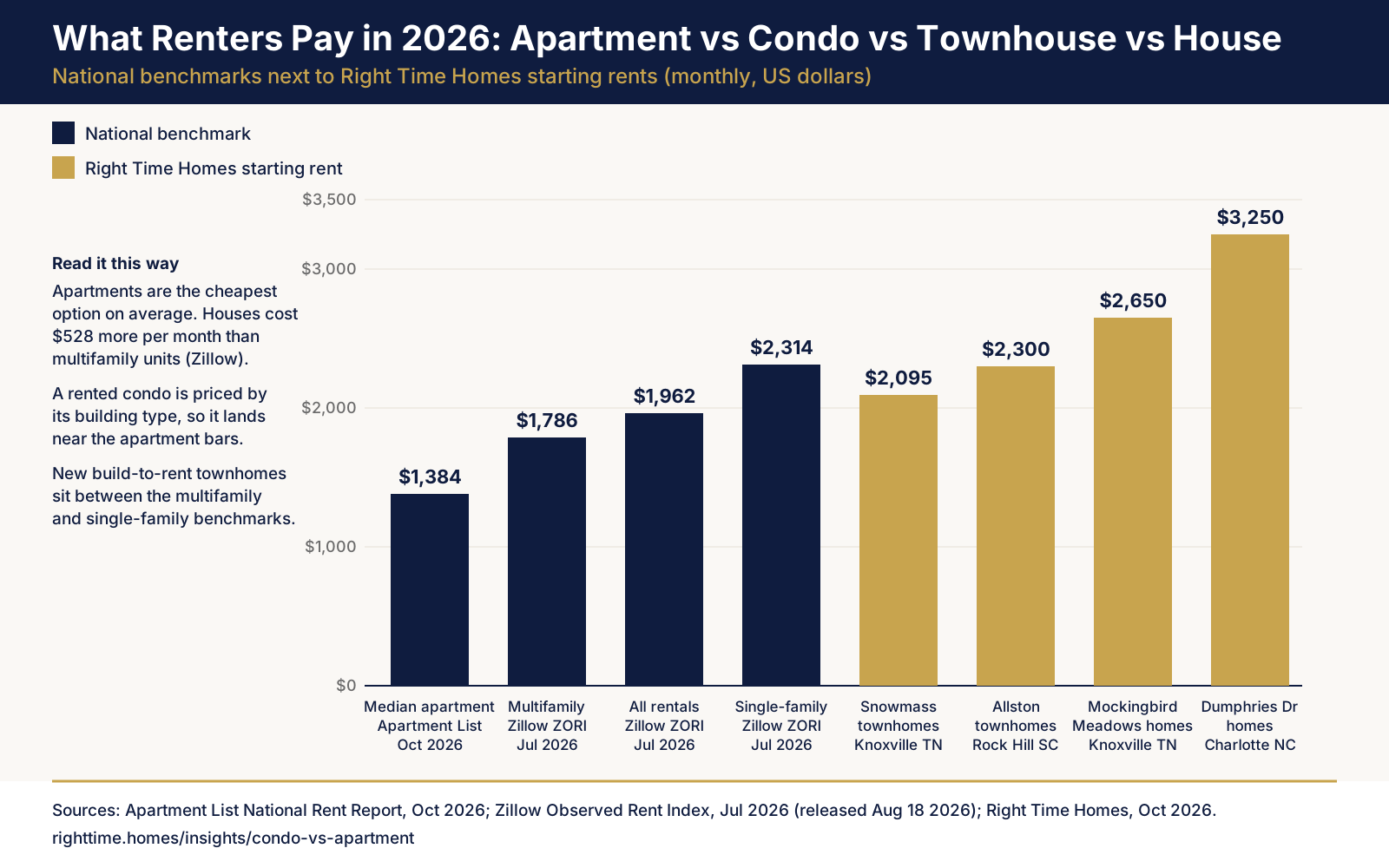
In 2026, apartments are the cheapest option on average and single-family homes the most expensive, with townhouses and rented condos in between. Zillow's July 2026 data put the typical U.S. multifamily rent at $1,786 and the typical single-family rent at $2,314, a gap of $528 a month, while Apartment List's October 2026 median apartment rent was $1,384.
The two national sources measure different things, which is why they disagree. Apartment List's National Rent Report (October 2026) tracks a median across its apartment listings: $1,384 overall, $1,215 for a one-bedroom, and $1,369 for a two-bedroom, up 0.1 percent year over year with a national vacancy index of 7.0 percent. Zillow's Observed Rent Index (release dated August 18, 2026) is a repeat-rent index weighted to the whole rental stock, which includes houses; it showed a typical asking rent of $1,962, up 2.3 percent year over year, with single-family rents rising 3 percent and multifamily rents 1.7 percent. Zillow also reported Charlotte's typical rent at $1,756, up 0.6 percent, with concessions offered on 68.1 percent of listings.
Condos do not appear as a separate line in either dataset because a rented condo is counted by its building type. A rented condo in a mid-rise shows up as multifamily; a rented condo townhouse shows up as single-family attached. In practice, condo rents cluster near apartment rents in the same building class, with a premium when the owner has upgraded finishes and a discount when the owner is motivated to avoid vacancy.
Here is how Right Time Homes' starting rents for new townhomes and single-family homes compare, using the national benchmarks above. Snowmass townhomes in Knoxville start at $2,095, which is $309 above Zillow's multifamily figure and $219 below its single-family figure. Allston townhomes in Rock Hill start at $2,300, close to the single-family benchmark. Poplar Creek townhomes start at $2,545, Mockingbird Meadows homes at $2,650, Amber Vista homes at $2,695, and Preston Park townhomes at $2,800. Green Meadows homes in Lenoir City start at $3,150 and Dumphries Dr homes in Charlotte at $3,250, reflecting larger detached homes.
A worked example shows why the comparison is not just about the headline rent. Suppose a renter is weighing a $1,786 two-bedroom apartment (the Zillow multifamily figure) against a $2,095 Snowmass townhome. The townhome costs $309 more per month, or $3,708 a year. For that, the renter gets a private entrance, no neighbors above or below, a garage, new construction, and a yard. If the renter currently pays $50 a month for an off-site storage unit and $75 a month for a garage or reserved parking space at the apartment, the real gap narrows to $184 a month. Whether that is worth it depends on the household, but the honest math is rarely as wide as the sticker prices suggest.
What's the difference between a condo and an apartment under Tennessee and South Carolina law?
Under both states' laws, a renter's protections come from the landlord-tenant statute, not from whether the unit is a condo or an apartment. The condominium acts (Tennessee Title 66 Chapter 27, South Carolina Title 27 Chapter 31) govern owners and associations. The landlord-tenant acts (Tennessee Title 66 Chapter 28, South Carolina Title 27 Chapter 40) govern your lease either way.
Tennessee has two layers of condominium law. The Horizontal Property Act (Tenn. Code 66-27-101 and following) governs condominiums created before January 1, 2009. The Tennessee Condominium Act of 2008 (66-27-201 and following, with its applicability set out in 66-27-202) governs condominiums created after that date, and some of its provisions reach back to older ones. Both acts deal with master deeds, common elements, assessments, and the association's powers. Neither one gives a tenant any direct rights; a renter's relationship is with the unit owner.
Tennessee's Uniform Residential Landlord and Tenant Act applies, per 66-28-102, in counties with a population above 75,000 according to the 2010 federal census. Knox County (Knoxville) is well above that line. Smaller counties such as Loudon County, where Lenoir City sits, fall below it, so a lease there is governed by its own terms and general Tennessee law rather than URLTA. Where URLTA applies, 66-28-301 requires the landlord to keep security deposits in a dedicated account at a regulated financial institution and tell the tenant where it is, and 66-28-403 lets the landlord enter to show the unit during the final 30 days of the lease only if the lease allows it and the tenant gets at least 24 hours' notice. Our security deposit guide walks through the deduction rules in detail.
South Carolina's Residential Landlord and Tenant Act applies statewide, including Rock Hill. Under 27-40-410, a landlord must return the deposit with an itemized written list of deductions within 30 days after the tenancy ends. Under 27-40-530, outside emergencies and scheduled services, the landlord must give at least 24 hours' notice before entering. Under 27-40-440, the landlord must "make all repairs and do whatever is reasonably necessary to put and keep the premises in a fit and habitable condition." Under 27-40-770, either party can end a month-to-month tenancy with at least 30 days' written notice.
The Dumphries Drive homes in Charlotte are in North Carolina, which sets its own rules: the North Carolina Condominium Act (Chapter 47C of the General Statutes) governs condo owners and associations, and Chapter 42 covers landlords and tenants, so check those rules or ask the leasing team before you sign.
The one place a condo renter's legal position really differs is enforcement of association rules. In both states, the association can fine the unit owner for a tenant's violation, and the owner can then pursue the tenant under the lease. The association generally cannot evict a tenant directly, but it can pressure the owner to do so, and in an extreme case can seek an injunction against the conduct.
| Rule | Tennessee (Knoxville, Knox County) | South Carolina (Rock Hill, statewide) |
|---|---|---|
| Condominium statute | Horizontal Property Act, Title 66 Ch. 27 Part 1 (pre-2009); Condominium Act of 2008, Parts 2 to 5 | Horizontal Property Act, Title 27 Ch. 31; regime created by recorded master deed (27-31-30) |
| Landlord-tenant statute | URLTA, Title 66 Ch. 28; counties over 75,000 (2010 census) per 66-28-102 | Residential Landlord and Tenant Act, Title 27 Ch. 40; applies statewide |
| Security deposit handling | Dedicated account at a regulated institution; location disclosed to tenant (66-28-301) | Itemized written statement and refund within 30 days of termination (27-40-410) |
| Landlord entry notice | 24 hours' notice to show the unit in the final 30 days, if the lease allows (66-28-403) | 24 hours' notice except emergencies and scheduled services (27-40-530) |
| Repair duty | Maintenance by landlord (66-28-304) | Keep premises fit and habitable (27-40-440) |
| Ending month-to-month | Set by lease and 66-28-512 | At least 30 days' written notice (27-40-770) |
| Who enforces HOA rules on a tenant | Association fines the owner; owner enforces lease | Association fines the owner; owner enforces lease |
Apartment vs condo vs townhouse: which should you rent?
Rent an apartment if you value convenience and predictability, a condo if you want a specific building or upgraded unit and are comfortable with an individual landlord, a townhouse if you need space, privacy and a yard, and a duplex if you want house-style living on a tight budget. Match the housing type to how you actually live.
Apartments suit renters who move often, travel for work, or want amenities without maintaining anything. The leasing office is open, the maintenance request goes into a system, and when the lease ends you hand back the keys. The trade-offs are shared walls on multiple sides, hallway living, and rent pricing that moves with the market.
Rented condos suit renters who have found a building they love, perhaps a downtown mid-rise with no rental competitors, or who want finishes that an apartment operator would never install. Before signing, ask for the association's rules and confirm the owner is allowed to rent. Ask who to call for after-hours emergencies. Ask whether any special assessments are pending. Expect to provide the owner with the same documentation a company would want, and if your credit or income is thin, read our guide to guarantors and co-signers, because individual owners often ask for one.
Townhouses suit families, remote workers, pet owners, and anyone tired of hearing footsteps overhead. In a build-to-rent community you get the professional management of an apartment with a floor plan that feels like a house. In an individually owned townhouse you get the same private-landlord dynamic as a condo. The difference between condo and apartment management styles applies to townhouses too, so ask who owns the home before you ask about the countertops.
Duplexes suit renters who want a yard and a quiet street and are comfortable with a very small landlord. The best duplex landlords live next door and fix things the same day. The worst are unreachable. Meet the owner, look at how the other half is kept, and get every promise in writing.
Finally, consider the age of the building. New construction has tighter building envelopes, modern electrical and plumbing, and energy-efficient appliances, which show up in lower utility bills and fewer repair calls. Our comparison of new construction vs older rentals covers that in depth.
How Right Time Homes fits the condo vs apartment decision
Right Time Homes builds new townhomes and single-family homes specifically for rent in Tennessee, South Carolina and North Carolina, then manages them as one company. That gives renters the thing a condo vs apartment comparison usually cannot: a house-style home with a private entrance, combined with one professional landlord, one maintenance team, and one clear lease.
In the Knoxville area, Snowmass townhomes start at $2,095, Poplar Creek townhomes at $2,545, Mockingbird Meadows homes at $2,650, Amber Vista homes at $2,695 and Preston Park townhomes at $2,800. Browse every Knoxville community on our houses for rent in Knoxville, Tennessee page. Nearby, Green Meadows homes in Lenoir City start at $3,150.
In South Carolina, Allston townhomes in Rock Hill start at $2,300; see all houses for rent in Rock Hill, South Carolina. In Charlotte, Dumphries Dr homes start at $3,250.
Because one company owns and manages each home, maintenance requests go to one team, and your lease is with the same company that looks after the home. If you have been comparing a rented condo to an apartment and wishing there were a third option with the best of both, that is the gap build-to-rent was designed to fill. To ask about a specific home, talk to our leasing team. For help with the application, our posts on what a guarantor is and how lease agreements work cover the questions renters ask most.
Frequently Asked Questions
What is the difference between a condo and an apartment?
A condo is an individually owned unit inside a building whose common areas are owned jointly by all the unit owners, so a condo renter's landlord is a private person. An apartment is a unit in a building owned entirely by one landlord or company. The buildings can look identical; the difference is ownership, management and which rules apply to you.
Is a condo cheaper to rent than an apartment?
Not automatically. Rented condos are priced by individual owners who must cover a mortgage, taxes, insurance and HOA fees of roughly $100 to $300 a month, while apartment operators price across a whole building. In the same neighborhood and building class, condo and apartment rents usually land close together, with condos carrying a premium for upgraded finishes.
Who fixes things when you rent a condo?
The unit owner is responsible for everything inside the unit, including appliances, fixtures and interior surfaces, while the condominium association handles the general common elements such as the roof, main walls, hallways and central systems. Tenn. Code 66-27-102(a)(7) and S.C. Code 27-31-20(f) define those common elements. Get the owner's emergency contact in writing before you move in.
Do HOA rules apply to renters in a condo?
Yes. A condo renter must follow the association's declaration, bylaws and rules in addition to the lease, covering things like pets, parking, noise and balcony use. The association fines the unit owner for violations, and the owner can enforce against the tenant under the lease. Renters have no vote in the council of co-owners that sets those rules.
What is a duplex apartment?
In most of the United States, a duplex apartment is one of two separate homes in a single building, side by side or stacked, each with its own entrance and kitchen. In New York City the term means a single apartment spanning two floors. Duplexes are counted as 2-unit structures by the Census Bureau and are usually owned by one individual.
Is a townhouse a condo or an apartment?
It can be either, or neither. "Townhouse" describes the building form: a multi-story attached home with its own entrance. Ownership decides the rest. Individually owned townhouses with a recorded master deed are condominiums; townhouses with separate lots are fee simple; and townhouses in a build-to-rent community are owned by one operator and rented like apartments, with one management team.
Does Tennessee or South Carolina law treat condo renters differently from apartment renters?
No. In both states, renter protections come from the landlord-tenant statute (Tennessee Title 66 Chapter 28 in counties over 75,000 people; South Carolina Title 27 Chapter 40 statewide), which applies regardless of whether the unit is a condo, apartment, townhouse or duplex. The condominium acts govern owners and associations, not tenants, so your lease rights are the same.
Sources
- Tennessee Code Annotated, Title 66, Chapter 27, Part 1 (Horizontal Property Act), section 66-27-102, definitions of apartment, condominium, council of co-owners and general common elements. FindLaw codes, accessed October 29, 2026.
- Tennessee Code Annotated, Title 66, Chapter 27, Parts 2 to 5 (Tennessee Condominium Act of 2008), sections 66-27-201 to 66-27-203, applicability to condominiums created after January 1, 2009. HOPB summary, accessed October 29, 2026.
- Tennessee Code Annotated, Title 66, Chapter 28 (Uniform Residential Landlord and Tenant Act), sections 66-28-102, 66-28-301, 66-28-304 and 66-28-403. Justia, 2024 code edition, accessed October 29, 2026.
- South Carolina Code of Laws, Title 27, Chapter 31 (Horizontal Property Act), sections 27-31-20 and 27-31-30. South Carolina Legislature, accessed October 29, 2026.
- South Carolina Code of Laws, Title 27, Chapter 40 (Residential Landlord and Tenant Act), sections 27-40-410, 27-40-440, 27-40-530 and 27-40-770. South Carolina Legislature, accessed October 29, 2026.
- U.S. Census Bureau, Housing Availability and Affordability: 2023, American Community Survey Reports ACS-61, Caroline Short and Christopher Mazur, September 2025 (units in structure shares, homeownership rate, median renter costs).
- Zillow Group, "Rents near $2,000, rising at the fastest pace in over a year," Zillow Observed Rent Index for July 2026, released August 18, 2026 (typical rent $1,962; single-family $2,314; multifamily $1,786; Charlotte $1,756).
- Apartment List, National Rent Report, October 2026 (median rent $1,384; one-bedroom $1,215; two-bedroom $1,369; up 0.1 percent year over year; vacancy index 7.0 percent).
- National Association of Home Builders, Eye on Housing, "Short-Term Townhouse Construction Weakness," Robert Dietz, August 20, 2026 (townhouse share 17 percent of single-family starts, Q2 2026).
- National Association of Home Builders, Eye on Housing, "Single-Family Built-to-Rent Slowed at Start of 2026," Robert Dietz, May 25, 2026 (62,000 built-for-rent starts over four quarters, just under 7 percent share).
- HomeGuide, "How Much Are HOA Fees? (2026)," Jennifer Carlson (average HOA fees $100 to $300 per month; range under $50 to $1,000). Accessed October 29, 2026.
- Right Time Homes community pages, starting rents as of October 2026.
Last updated: October 30, 2026
Andrew Garza
Real Estate Development Editor
Andrew Garza writes about rental market trends, new-construction homes, and the rent-versus-buy decision for Right Time Homes across Tennessee, North and South Carolina.